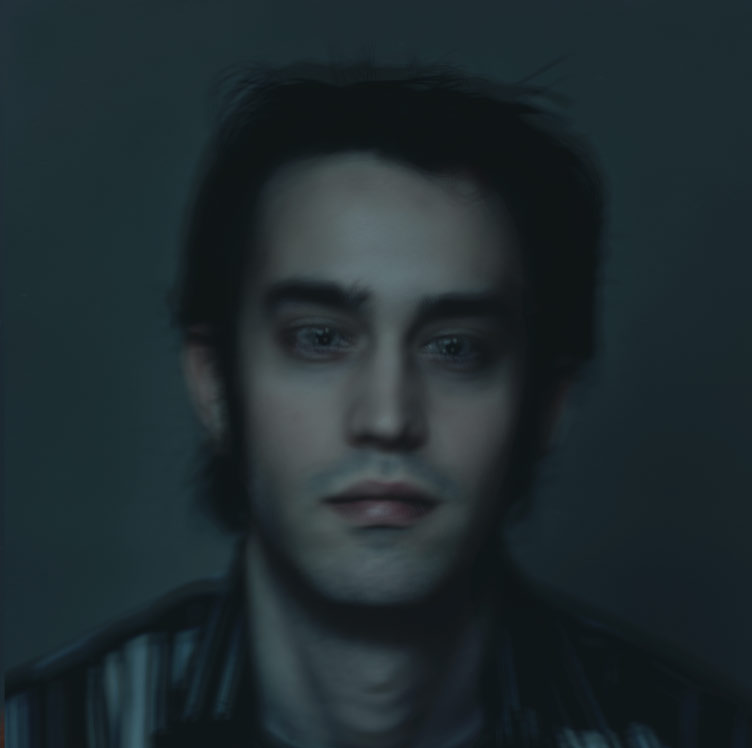
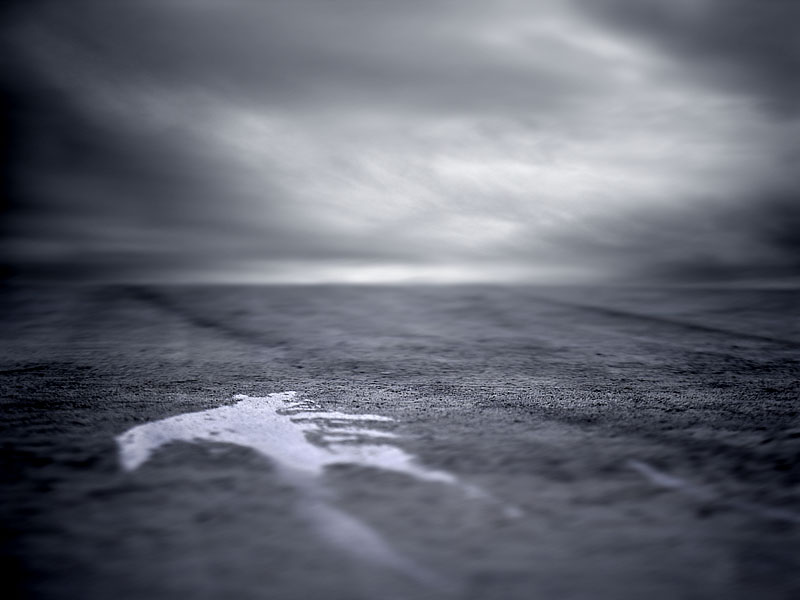
Robert ParkeHarrison: The Architect's Brother, The Sacrifice
Еще одна ссылка:
Robert ParkeHarrison: The Architect's Brother
 Windwriting
Выставка, доступная для показа на определенных условиях, Traveling Exhibition:
Robert ParkeHarrison: The Architect's Brother
Robert ParkeHarrison's innovative approach to picture-making draws upon the use of the paper negative and collage to construct stories of healing and restoration amid landscapes scarred by technology and over use. In herculean actions that are both humorously metaphorical and lyrically poetic, ParkeHarrison constructs beguiling stories that gently remind us to consider the state of our one and only earth.
At the center of each of his pictorial tales is a lone individual—ParkeHarrison himself as "everyman"—the "architect’s brother." This suit-clad figure patches holes in the sky, creates rain machines, chases storms to create electricity, and communicates with the land to learn of its needs.
ParkeHarrison’s wife Shana is his collaborator in all works which have received world-wide critical acclaim. This is their first solo museum exhibition and tour. The Architect's Brother has been published as a monograph by Twin Palms Press and is available to accompany the exhibition. The ParkeHarrisons are often available for lecture.
http://www.eastmanhouse.org/inc/exhibit ... rrison.pdf
Все снимки:
http://www.geh.org/parkeharrison/index.htm
Часть крупных версий снимков оттуда на одной странице:
http://www.gustaff.ru/post37231504/
*
Robert ParkeHarrison, The Architect's Brother
" I love to try to capture that quality of the Earth looking like the world's just started or been destroyed and is starting all over again -- that feeling of being way back in the past or way ahead in the future," ParkeHarrison explained in an ArtNews interview in March 2001. "Some of these acts are impossibilities, of course, or dreams, like controlling the weather. What would that be like&?hellip;A lot of people can associate with this character because he's not heroic. He's slightly failing. Maybe when we see someone like this who isn't idealizes and is sort of sad, we identify."
Robert ParkeHarrison: The Architect's Brother is divided into five different sections: Exhausted Globe, Industrial Landscapes, Promisedland, Earth Elegies, and Kingdom. He has been influenced by photographers Edward Steichen, Clarence H. White, Oscar Rejlander, and Timothy O. Sullivan, Lucas Samaras and Ruth T. Thorne-Thomsen. His inspiration has come from Thomas Edison, Leonardo da Vinci, and George Orwell, along with personalities from theater and cinema. Each image takes about five weeks to create and begins with notes and drawings made in a sketchbook, as well as library research. ParkeHarrison then builds the set and the props and photographs a carefully-staged image.
http://www.uwyo.edu/ArtMuseum/displaypa ... hibitid=32
 Pollination
The Mary Brogan Museum of Art and Science
THE ARCHITECT'S BROTHER : December 8, 2007- February 3, 2008
Written by Cynthia Hollis
In this exhibition, photographer Robert ParkeHarrison conjures a destiny in which humankind's overuse of the land has led to a spent and abandoned environment, inhabited by one indefatigable spirit (portrayed by ParkeHarrison). Donning the ill-fitting suit of the Everyman, ParkeHarrison is the earthbound relation of the Creator-the Architect's Brother-complete with human foibles. With lyric poeticism and wry humor, he is the romantic anti-hero, taking up tasks of preservation that appear futile: he attempts to patch holes in the sky, construct rain machines, and chase storms to create electricity. While doing so, ParkeHarrison also lays the foundation for the potential redemption of the natural world.
…His inspiration has come from Thomas Edison, Leonardo da Vinci, and George Orwell, along with personalities from theater and cinema. Each image takes about five weeks to create and begins with notes and drawings made in a sketchbook, as well as library research. ParkeHarrison then builds the set and the props and photographs a carefully-staged image.
http://www.thebrogan.org/index.php?opti ... 0&Itemid=1
A visionary moved by the earth's plight
By Jennifer Wolcott | Correspondent of The Christian Science Monitor
 'FOREST BED': From the 'Promised Land' series, 1998,
gelatin silver print and mixed media on panel by Robert ParkeHarrison.
The artist appears as an Everyman figure in his works,
which are photographed by Shana ParkeHarrison.
…Inspired by the classic story of "The Little Prince," among many other cultural and historical influences, the ParkeHarrisons' collaged works - mostly either photogravure prints or gelatin-silver prints and mixed media panels - always feature a lone man in a barren world. While struggling to eke out an existence, he takes an interest in preserving the natural world around him. Representing this man is ParkeHarrison himself, who appears in every image as the stand-in for humanity, or Everyman. He wears the same tight-fitting dark suit, white oxford shirt, and slightly worn dress shoes.
Their Everyman evokes quiet reflection, curiosity, and the occasional chuckle as viewers observe his preoccupation with pursuits both serious and absurd.
In "Cloud Cleaner," for example, a gelatin silver print and mixed media on panel constructed in 1999, he carries a backpack full of mops and brushes as he looks up at a dark, ominous cloud. In his 2000 image "Flying Lesson," ParkeHarrison holds both a large birdcage containing a single crow and several other lassoed birds that soar upward as they attempt to pull him up behind them. And in "Mending the Earth," the figure attempts to sew together a deep crack in the earth's surface with an enormous needle.
Their images can be interpreted in many ways, but one thing is certain: They stir thought, says Diana Gaston, a contemporary art curator who narrated a recent public-television special about the ParkeHarrisons' work. "The images make us reflect on our role within the universe," says Ms. Gaston. "The ParkeHarrisons don't lecture us about the environment. Instead, they are all about posing questions and getting us to think about what we are doing."
The ParkeHarrisons don't take shortcuts. Each image takes several weeks of continuous work to complete. Their artistic journey begins by investigating a variety of subjects, including art, film, theater, dance, as well as texts on spirituality, literature, and mythology. During this research stage, says Robert, they are "filling the well" with possible ideas. Then they choose one idea for which they construct a set and sculptures out of their home studio in Great Barrington, Mass.
The work is subsequently moved outdoors - but only at dawn or dusk or on "a perfect cloudy day," he says. "We prefer softened light, and the quality of outdoor light at those times is exactly as we like it." After experimenting with various gestures and movements, Robert takes his agreed-upon pose as Everyman and Shana gets behind the camera to further direct the action before she releases the shutter.
Back in the darkroom, the ParkeHarrisons produce paper negatives, about three to seven of which are pieced together to create the finished image. "We don't want to be restricted by what we see in the lens," says Shana, "so instead of accepting the reality of a single photograph, we manipulate many photographs and layer images just the same way that we layer ideas. We use so many techniques to make the final image; photography is just the recording device."
…
http://www.csmonitor.com/2004/1112/p12s01-alar.html
См. еще реплики здесь:
http://www.flickr.com/photos/marybogdan/143643361/
My husband and I got to the campus about five minutes before the place opened, skies were dark and ominous. As soon as the doors opened, we raced downstairs to the gallery where "Architect's Brother" was being exhibited. It was just us, quiet, meditative, peaceful. The photos were stunning and evocative and I was so pleased to see them printed so large. Even with their size (some must have been 3 x 3'??) they were still delicate, dreamlike, fragile and soft in a way I hadn't expected--painterly.
The images handled these terrifying environmental themes with a gentleness and caring that made me want to crawl into them and be of some help. I especially loved the pieces that were not behind glass, but were mounted like canvas paintings. There was no barrier to the experience of them, no reflections on glass to bring you out of this dark yet hopeful reverie. I loved the scale within the images, with fragile twigs and strings holding up huge looming clouds and bodies. I felt as though I was seeing images from my dreams brought somehow into the waking world. They really, to me, felt like coming home. It was a show I will never forget. I wish everyone could see this. I feel like I'm not the same person for having experienced these pieces. Breathtaking, sad, dreamy, hopeful. I cannot say enough about it all.
Интервью (фр.) : Obscurs objets du rêve par Shana et Robert ParkeHarrison
http://www.bulbe.com/fr/themes/rever/parkeharrisson.php
Другие работы Robert'а и Shan'ы ParkeHarrison см. на странице
Jack Shainman Gallery:
 Undergrowth, 2006
C-print on aluminum with acrylic, 60 x 60 inches
http://www.jackshainman.com/dynamic/art ... tistID=136
Сайт авторов:
http://www.parkeharrison.com/