О!
У них имеется свой Саша Пасканной (
http://www.infrance.ru/forum/showthread.php?t=33859 )!
Антон СОЛОМУХА : Нічний Париж (
http://www.kut.org.ua/art_a0037.php )
*
Но я, в общем, скорее вот про это (
http://www.kut.org.ua/art_a0066.php ) :
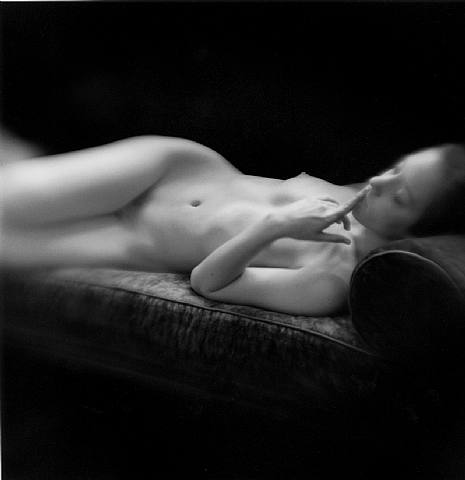
Дзеркало жінки (Miroire de Femme), Антон СОЛОМУХА (Anton SOLOMOUKHA)
«Ідея цього фотоциклу — модель та її віддзеркалення, її роздвоювання створює подвійне зспоглядання: по обидва боки дзеркала. Фотограф зі своїм об'єктивом дивиться на подвійну мізансцену та дублює її. Але це все не ще: глядач дивиться на модель, яка дивиться на своє відображення, яке дивиться на модель, на які дивиться фотограф з об'єктивом свого фотоапарату...»
*
Или, если точнее, то вот про это:
http://www.art-gu.ru/gallery/a_list.pht ... Solomoukha
Или, если полнее, то вот это:
http://www.artmajeur.com/?login=solomou ... _galleries
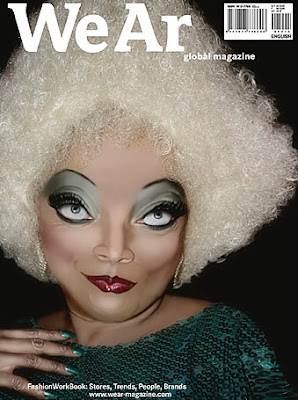
Собственно, это все в связи с тем, что в новом Eyemazing — большая статья (
http://www.eyemazing.com/ ) :
Anton Solomoukha
Little Red Riding Hood Visits the Louvre
If he were a character in a fairy tale, he would probably be called the “Cheery Eccentric”. Anton Solomoukha might indeed enjoy that. Fairy tales — Little Red Riding Hood amongst others — fascinate this voluble painter-turned-photographer whose work breathes irony and erotic fantasy.
Born in Kiev, in Soviet-controlled Ukraine, Solomoukha boasts of never having suffered under Communism. In 1978, at the age of 29, he nevertheless seized an opportunity to emigrate, arriving in Paris at a time when it was “absolutely impossible” he says, to leave the USSR. How did he do it? Easy. “I married a woman who was doing a doctorate in musicology in Kiev. Her mother was from Guadalupe. I told the Soviet authorities I wanted to go to France to study the plight of workers from Guadalupe. Thanks to my wife’s French nationality, the Soviets gave me permission to leave for a month, and I never went back.”
At the Parisian gallery that represents him, Solomoukha continues to spin effusive yarns for me about his youth in Kiev and his photography career in France. “I find it fascinating to talk about myself!” he exclaims, bursting into laughter.
Barbara Oudiz (BO): Life for you as a student and an artist in Communist Ukraine was not particularly difficult, you say. Isn’t that surprising?
Anton Solomoukha (AS): My father was an official in the education department of the government. That’s why I always had very good relations with big wigs in the Soviet regime. As a result, I never had the slightest problem in the USSR. All I had to do was phone the police! This was in the days of Khrushchev, when there was a certain degree of openness, and so my father didn’t work in a repressive structure. On the contrary!
...
BO: And after your military service, you entered art school in Kiev.
AS: I studied at the best Fine Arts school in Ukraine with a fabulous professor who was very well known at the time, Tatiana Yablonskaia. I studied there from age 21 to 27, and did two doctorates. It was a very positive experience for me, even though the courses were very classic and demanding. The level was very high and the selection process was extreme. Each year they weeded out dozens of students. Seven or eight hours a day were devoted to drawing, five or six hours to painting, and in the evenings we studied Marx. Or rather Marxist-Leninism.
BO: The Socialist Realism ideal was still in full swing then. How did that affect you?
AS: Socialist Realism was actually very good for us artists! We could earn money by making official art! Each exhibition contributed to the Revolution, to industry, to the Kolkhoz, or to some other official cause and so our work was bought by the state (laughs). We were the elite!
BO: And you became a successful painter in Kiev?
AS: I have pursued an artistic career all my life. There were moments of great success. I won many second prizes in painting and drawing competitions. I always came in second, though. And I know why. It’s because a gallery didn’t represent me in those days. I was independent, so I always got the jury’s prize, but never first prize.
BO: How did you get involved in photography?
AS: I’ve only been doing photography seriously for about fours years. While my daughter was at art school, she used to criticize me and say that I spent all day with my paintbrushes and never looked around me, never noticed what was going on in the outside world. It was a joke between us, but one day I took it to heart and made a decision: everything I hated most, I would study! And since I hated photography, I decided to take it up.
At first I did it especially to flirt with women. I’d make portraits of women to get to know them. I used to save the images to use later for my painting. Then the Director of the Russian Photography House — which is like the Maison Européenne de la Photo in Paris — came to my studio one evening. She looked at the dozens of slides I had taken and told me: you have to become a photographer! So I started forging my path. Over the past four years, I’ve been in at least 70 group or solo exhibitions. That’s almost an exhibition every month. For a gallery owner, representing a painter is like marriage. Whereas the relationship between a gallery owner and a photographer is like adultery. It’s just a fleeting affair, a much “lighter” relationship.
BO: Tell us about the genesis of the Little Red Riding Hood Visits the Louvre project.
AS: I was seeking a way of bringing together something very contemporary with something very classic. Popular fairy tales, like those by Perrault and Grimm, actually castrated fairy tales, they emptied them of meaning. They made them very moralising and Christian. Perrault says basically that if Little Red Riding Hood had listened to her parents, she wouldn’t have gotten into trouble. But she had listened to her parents! She was not at fault! No one was at fault here! There is no moral issue in these tales! That’s what’s so powerful about them.
BO: What is this fairy tale all about, then?
AS: That’s is a good question. What is moral? What is good and bad? What is religion? What makes a girl become a woman? What makes a girl have her first period? Little Red Riding Hood was a little girl with her first period. That’s what Freud says. It is her sexuality that is emerging. And all the dangers that come with sexuality. The wolf, according to some interpretations, is the lover, according to others, the father. Why does the grandmother die? Because a woman is born, i.e. Little Red Riding Hood, and an old woman dies. The wolf, the lover, replaces the grandmother.
BO: And the visit to the Louvre?
AS: For me, the spirit of Little Red Riding Hood is like that of a newborn, or like the mind of a child. It is a new and feminine spirit. It is “mature” innocence. Why did I want her to visit the Louvre? I want her to confront life through art. I believe that the concentration of life can be found in art. I’ve understood more about history by looking at paintings than by reading books! This Little Red Riding Hood goes to the Louvre and looks at the paintings, and because she’s still a child, she imagines herself as the Infante Margarita in Las Meninas by Valasquez or as Suzanne in portraits by Rubens.
BO: More often than not, you pose in these staged series.
AS: Yes, but this is not out of narcissism. Although I see narcissism as a very positive thing! It’s the beginning of Christianity. Jesus’ most important rule is “Love your neighbour as you love yourself”. I love myself a lot, luckily! Good thing, because if you don’t love yourself, you’ll never make it… It’s often more out of convenience that I pose. Sometimes I just don’t find the right model. Or I replace a model in a photo when a shoot didn’t work out as expected.
BO: In your earlier series, such as Lolita, the Mechanical Doll, there was only you and your model. Why?
AS: The relationship between a photographer and his model is something very intimate. Lolita was a very interesting, very intimate project. Tatania, the model, was 18 years old when her mother brought her to me to be photographed. People see something erotic about the series, yet Tatania is never nude in these images. The idea was to construct images in relation to literature. A man, an artist, finds a sort of big damaged doll, and he repairs it. She becomes his wife and then she leaves him. It is in fact the opposite of Nabakov’s book. I worked with another woman named Irma in The Sex of Angels and the I Fuck your TV series, which was the first series I ever showed. They were all bought by people working in TV. I put Irma on all fours on a table in front of me, and instead of watching TV, I watched her backside. I got lots of letters about that series.
BO: And you say don’t see your work as erotic fantasy?
AS: I am not the right person to speak about eroticism. I see my work as being glacial, very cold and cerebral. All my models are so covered with powder and talc that they become like marble. You wouldn’t know it, but they are actually very made up. I study their bodies enormously. I spend the first three or four sessions just analysing the body and the effects light has on the body. This is a necessary step for me, and it kills all sexual desire. The relationship with my model becomes rather perverse in fact, because she shows me everything, and I become practically absent. I’m behind the camera. The only relationship between us is in the eye. I become a tyrant. I draw and use Photoshop to imagine the staging of the scene. I create the scene first in Photoshop using bits of existing paintings, so that I can imagine the scene before shooting it. I scream! And my models laugh! I am extremely demanding and meticulous!
...
BO: Getting back to the Little Red Riding Hood series, I believe it is scheduled to become a book?
AS: Yes, it should be published this year. It’s a project that consists of grouping some of my paintings and drawings, and lots and lots of my photographic portraits of various people dressed up as Little Red Riding Hood in scenes evoking paintings. I already have some 1,200 photos of models between 7 and 65 years old. Approximately 150 to 200 different people have posed for me so far. I keep the costumes handy in my studio and bring them with me when I travel. So I photograph people in the role wherever I happen to be. Some very well-known people have posed for these scenes, such as Thierry Fremont, CharlElie Couture, Pierre Cornet de Saint Cyr, Malaury Nataf, Louis Rego, and Baudoin Jannink.
BO: How do you find these people?
AS: I always find them the same way. When I look at someone, I know in which painting at the Louvre I’ve already seen him or her. I find that the history of art is a condensed version of the history of humanity. Nietzsche once said, “In answer to a question about what purpose art serves, that art allows us not to die from the truth of life.” In German it must sound much more elegant. I hate life that doesn’t reflect art in some way!
BO: This book will be a way of expressing your life through art?
AS: It will be an album that reflects my vision of what an image is. It will show how I think. When I take a picture, it is to remind people of a work of art in the Louvre rather than anything that they have already seen. I prefer my photographs to resemble famous works of art rather than the cover of Elle, for example. We can’t compete with advertising images! I do something completely different, something totally personal.
This project has been slowly gestating for the past four years; I’ve been working on it seriously for about a year now. The book will include roughly ten articles and 300 visual documents – I might add, for example, a small picture of a sculpture by Rodin that will show the position of a body that interests me. I don’t need an editor for this book. It will probably be published in a limited series of 300 copies thanks to my sponsors – people in the financial world, bankers, etc. These people love my work and buy my photographs. This has allowed me to publish other books too, under the label, AS Editprod. My next book might also be under this label. But I’m not worried. Every time I meet a prospective publisher, he asks me: “Who takes the pictures?” Me, I say. “Who pays to get the book published?” Me. “Who writes the texts?” My friends. “What do I have to do?” Just put your name on it. And they say ok (laughs)!
BO: What new projects are in the works?
AS: There are lots and lots. I would like to do a story about the relationship between the body and food. I’d also like to re-do all the advertising photos that exist and make them resemble works by Rembrandt for example, to ridicule them. I don’t know which idea will emerge yet.
Text by Barbara Oudiz
http://www.solomoukha.com
Gallery:
Galerie 208 Patricia Chicheportiche, Paris
www.galerie208.com

Exhibitions:
October 25-November 26, 2007
Art 208 Gallery, Paris
Anton Solomoukha Le Petit Chaperon Rouge visite le Louvre
Paris Photo 2007